MUSICA PER GLI OCCHI: BERNARD HERRMANN
a book by Mr.Doctor
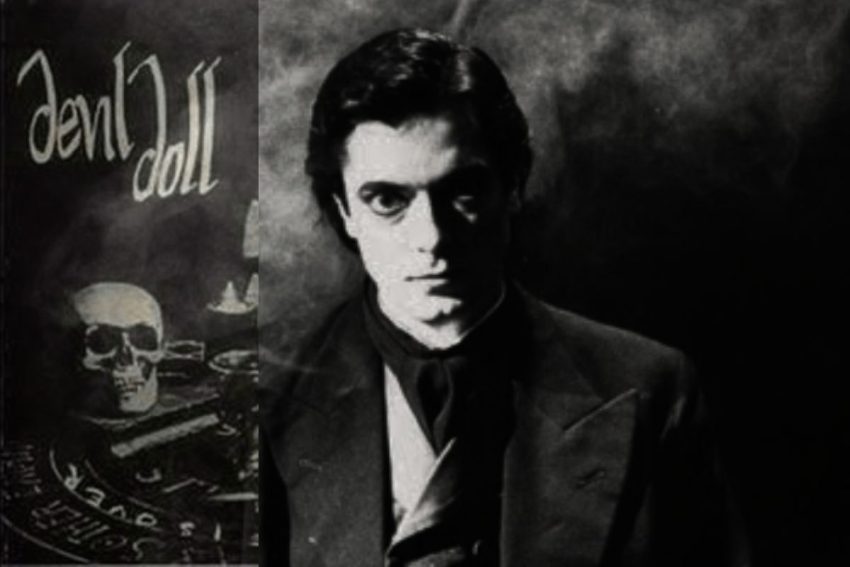
One of the rarest Devil Doll-related items is undoubtedly Mr.
Doctor's book MUSICA PER GLI OCCHI, written in the late `90s in both
Italian and Slovene language. The latter edition, entitled GLASBA ZA
OCI was financed by Slovenian National Cinematheque but it was
apparently withdrawn immediately after (or immediately before?) its
printing for reasons still obscure: IT IS A FACT THAT MR. DOCTOR
WOULD REFUSE ANY FURTHER COLLABORATION WITH THAT INSTITUTION. Through
the years we made many calls to Slovenian Cinematheque trying to
understand IF the book really existed but the results were
frustrating to say the least: we were said that the book was sold out
and going to be re-printed soon, then we were said by another person
that there had been some unspecified "problems" and the book had been
shelved.
The Italian edition was not easier to locate: we knew it had
been put for sale in 1999 at the Pordenone Film Festival but it took
quite a long time to locate a copy, but finally we have it in our
hands!! Bound in black velvet with gold inscriptions, it is a
luxurious edition of 255 pages written by Mr. Doctor with help from
Devil Doll piano player Francesco Carta and it is copyrighted 1998.
Apart from an introduction on Film Music in general, the book opens
with a short biography (pages 13-19) of Bernard Herrmann (born June
29th, 1911, in New York, the son of Russian Jewish parents emigrated
to the States less than 20 years earlier: the father, Abraham
DARDICK, had changed the family name into the German-sounding
Herrmann a few years after re-locating to New York).
Pages 20-26 are devoted by Mr. Doctor to an analysis of Herrmann's compositional
style, his "music of the irrational" with an enlightening explanation
of the technical devices which make Bernard Herrmann's music so
distinctive and unique: with elegance and clarity Mr. Doctor succeeds
in revealing us the musical essence, the magic formula, the
thumbprint of the man who has changed the world of Film Music. The
main part of the book is devoted to an analysis, film by film, of
Herrmann's scores (51 in all, spanning four decades): Mr. Doctor
transcribes hundreds of themes from the scores and captures
the "chemical formula" behind the subliminal effect of a certain
motif. MUSICIANS AND MUSIC EXPERTS WILL FIND THE EXPLANATIONS
TECHNICALLY FLAWLESS but the untrained reader will nevertheless be
delighted as the effect of the music on the mind is extremely
interesting and easily understandable.
Among the films analysed there are the Orson Welles-directed CITIZEN KANE
and THE MAGNIFICENT AMBERSONS, plus JANE EYRE with Welles in the main role. HANGOVER
SQUARE, the 1945 film-noir directed by John Brahm (and well-known to
Devil Doll fans via its main character George Harvey Bone, mentioned
in Dies Irae's sleeve notes) and its CONCERTO MACABRE FOR PIANO AND
ORCHESTRA are also put under Mr. Doctor's magnifying-glass. Apart
from the famous soundtracks written for Alfred Hitchcock (AMONG WHICH
PSYCHO AND VERTIGO WERE `QUOTED' ON SACRILEGIUM AND THE SACRILEGE OF
FATAL ARMS), MR. DOCTOR's BOOK PRAISES A FEW FOR MOST PEOPLE UNKNOWN
SCORES, such as A HATFUL OF RAIN and THE EGYPTIAN (OF THE LATTER
MR.DOCTOR SUGGESTS TO BUY A VERSION ON THE VARESE SARABANDE LABEL
WITH CAT.NO. VSD-5258) and, interestingly, REVEALS THAT THE MAIN
THEME OF CAPE FEAR (with Gregory Peck and Robert Mitchum, 1962)
WAS "NICKED" BY HERRMANN FROM ARNOLD SCHOENBERG'S FIRST
KAMMERSYMPHONIE. No, don't worry: the "fantasy" movies for Harry
Harryhausen and the two science-fiction films scored by Herrmann (the
masterpiece THE DAY THE EARTH STOOD STILL, 1951, and FARENHEIT 451,
1971, of WHICH MR.DOCTOR PRAISES THE STORY – by Ray Bradbury – and
the music but heavily criticizes the flat direction by Francois
Truffaut) are all scrutinized, as are the two collaboration with
Brian DePalma (SISTERS and OBSESSION) and the final soundtrack TAXI
DRIVER, written by Herrmann few weeks before his sudden death in the
night between December 23rd and 24th, 1975. MUSIC FOR THE EYES is
completed by an analysis of Herrmann's music for television (most
notably for Rod Serling's TWILIGHT ZONE: MR. DOCTOR SEEMS TO
APPRECIATE IN PARTICULAR THE SCORE TO THE EPISODE LITTLE GIRL LOST),
his classical compositions (a Symphony, a Sinfonietta, the opera
WUTHERING HEIGHTS, a string quartet, the clarinet quintet, the Moby
Dick Cantata etc), a listing of all his recording sessions and an
exhaustive Discography. The book, as I said, is very hard to locate
but is well worth the effort and I cannot recommend it enough!!
W.Timmer - www.devildoll.nl